
Facility manager reviewing FM documentation at a daytime office desk
The Audit Call You Were Not Ready For
The call comes with two weeks’ notice. A fire safety audit. A landlord inspection. An insurer’s annual review. A new client’s due diligence visit. The specifics vary, but the reaction is usually the same: two weeks of scrambling to pull together documentation that should have existed all along.
It is one of the most common scenarios discussed in FM forums and professional groups. The audit itself rarely fails on technical grounds — most FM teams know how to run their sites. What fails is the paper trail. The evidence that proves the site is being managed correctly does not exist, is not current, or is scattered across email threads, spreadsheets, and filing systems that only one person knows how to navigate.
The question is not whether your site is well managed. The question is whether you can prove it in the next fourteen days.
Why FM Documentation Falls Behind
In most FM operations, documentation is reactive. A record gets created when something goes wrong, when a contractor asks for it, or when an audit is already scheduled. The gap between how the site is actually run and what exists on paper widens quietly over months until something forces the issue.
The root cause is not negligence — it is the absence of a standard document set. Most FM managers inherit a site with partial records, build on what they find, and never establish the baseline from scratch. The result is an operation that runs well but cannot demonstrate that it does.
There are five documents that resolve this. Not a full quality management system. Not an ISO implementation. Five documents that, if maintained regularly, give you a defensible audit position on any site at any time.
The 5 Documents — and What Each One Proves
1. Risk Register
This is the single most requested document in any FM audit. Insurers want it. Board committees want it. Health and safety inspectors want it. A risk register proves that you have identified what could go wrong on your site, assessed the likelihood and impact of each risk, assigned ownership, and defined mitigation actions. Without it, your audit response to “How are you managing operational risk?” is a verbal explanation — which carries no weight.
2. Vendor Onboarding Checklist
Every contractor who sets foot on your site is a liability exposure until their documentation is verified. Insurance certificates, method statements, site induction records, access permissions — if any of these are missing and an incident occurs, the liability question comes back to the FM team. A completed vendor onboarding checklist for each active contractor is your evidence that due diligence was done before work began.
3. Preventive Maintenance Calendar
Reactive maintenance is expensive and hard to audit. Planned maintenance is cheap to document and straightforward to verify. A PM calendar showing what was scheduled, what was completed, and what was deferred — with a reason — is the difference between an audit conversation about your maintenance strategy and one about why the air handling unit has not been serviced in eighteen months.
4. Lease Abstract
For leased properties, an auditor or landlord representative will want to know that the FM team understands its obligations. Break clauses, rent review dates, service charge caps, permitted alterations, and reinstatement requirements are all FM responsibilities that live in a lease document most FM managers have never read in full. A lease abstract — a structured one-page summary of the critical terms — demonstrates that the FM function has its commercial obligations under control.
5. Cost Variance Tracker
Budget adherence is an FM performance metric in almost every organisation. An auditor reviewing FM operations will ask how actual spend compares to budget, and what the explanation is for variances. A cost variance tracker that shows monthly actuals against budget, with narrative notes on significant variances, turns a potentially uncomfortable conversation into a straightforward one. It also signals that the FM function is managing its financial obligations proactively, not reactively.
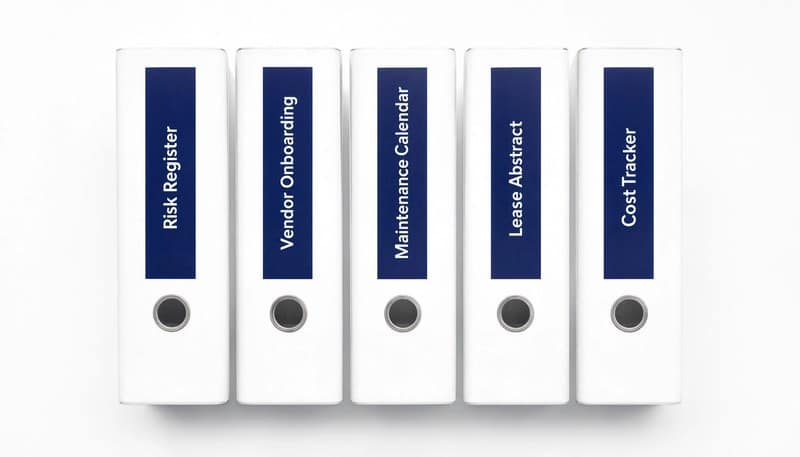
The five FM documents every site should maintain: Risk Register, Vendor Onboarding, Maintenance Calendar, Lease Abstract, Cost Tracker
What Two Weeks Without These Documents Looks Like
Early in my career I took over an FM role on a manufacturing campus in Asia-Pacific that had recently changed management. The previous team had left minimal documentation. Three weeks after I started, an insurer’s annual site review was confirmed.
We had two weeks. We had no risk register, a partial vendor file with expired certificates for two of our major contractors, a maintenance log that existed only as handwritten notes in a site diary, and no structured record of how lease obligations were being tracked.
We passed the review — but only by working nights and weekends to reconstruct documentation from memory, contractor calls, and email archives. It was entirely avoidable. Every hour spent in that scramble was time taken from running the site. After that experience, I established these five documents as the baseline on every site I managed. They take perhaps two to three hours per month to maintain. The audit preparation they replaced used to take two weeks.
| “In 20+ years of FM operations across Asia-Pacific and Europe, I have seen this problem repeated at every level of building complexity. The documentation gap is rarely about competence — it is almost always about the absence of a standard set of documents that every FM operation should maintain as a baseline.” |
The Document Set, Ready to Use
I have packaged all five of these documents — the Risk Register, Vendor Onboarding Checklist, Preventive Maintenance Calendar, Lease Abstract Form, and Cost Variance Tracker — into the BizzXpert FM Operations Playbook Pack Starter tier. Fully editable Word and Excel files, structured for immediate use.
→ Get the FM Operations Playbook Pack — Starter Tier at the BizzXpert Store