
Facilities manager reviewing monthly reports late at night at a corporate office desk
The Pain No One Talks About Openly
It is the last working day of the month. You have spent the past three days pulling utility figures from the BMS; chasing down contractor invoices that haven’t been coded correctly; reformatting a compliance table that your finance team keeps returning because the columns don’t match their template; and writing narrative summaries for ten cost centres — each with a slightly different story to tell. You finally sent the report at 9:47 PM. Your director’s one-line reply arrives the next morning: “Thanks. A few questions on the variance column.”
If this sounds familiar, you are not alone. On r/FacilityManagement and in IFMA community forums, the monthly reporting cycle comes up repeatedly — not as a technical problem, but as a time drain that professionals have quietly accepted as part of the job. The average time cited is somewhere between 8 and 14 hours per cycle. For a 20-site operation, it can be significantly more.
Why It Takes So Long — and What It Actually Costs
The problem is structural. FM monthly reporting has no standard format. Every organisation builds its own template — usually in a spreadsheet that has been extended and patched over several years by people who are no longer with the company. The result is a document that is difficult to populate, hard to read, and almost impossible to hand off to someone else.
The typical reporting cycle breaks down like this:
- Data collection from disconnected sources: 3–5 hours
- Manual entry and formula checking: 1–2 hours
- Narrative writing for each section: 2–3 hours
- Formatting, alignment, and version control: 1–2 hours
- Internal review cycles and revisions: 1–3 hours

FM monthly report documents on a desk with clock showing a late-night work session
None of this work requires specialist FM knowledge. Most of it is administrative overhead created by a poorly designed reporting structure. Every hour spent reformatting a cell or chasing a missing invoice is an hour not spent on site inspections, vendor performance, or planned maintenance — the work that actually protects the asset and justifies the FM function.
What a Bank Branch Network Looks Like at Month-End
Early in my FM career, I managed a multi-site bank branch network across Asia-Pacific. Month-end was a known pressure point. Each branch submitted figures through a mix of email attachments and shared network folders. There was no consistent structure, no mandatory field format, and no single point of truth for cost variances.
The first thing I did was impose a single reporting template across all sites — a document with locked input fields, a fixed narrative structure, and a cost variance section that automatically highlighted anything outside a 5% threshold. What had taken 12 hours per month dropped to under 3 within two reporting cycles. The content did not change. The discipline and the structure did.
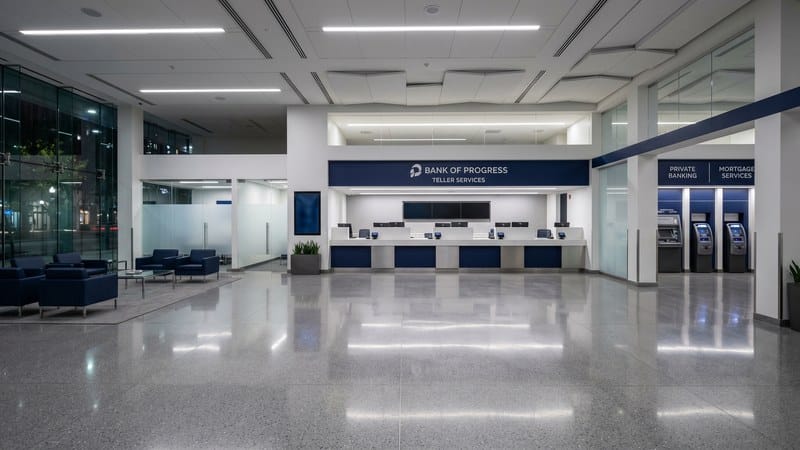
Modern commercial bank branch interior representing multi-site facilities management operations
What a Good FM Monthly Report Actually Looks Like
A well-designed FM monthly report has six characteristics:
- A fixed structure that does not change month to month. Readers know where to look.
- Automated variance flags. Anything outside tolerance should be visually obvious without the reader needing to calculate it.
- A single narrative summary per section — two to four sentences, not a paragraph per cost line.
- A consistent cost table format that maps directly to your budget headings.
- A compliance status section that is updated, not recreated, each month.
- An executive summary page that a non-FM director can read in under two minutes.
When these six elements are in place, monthly reporting becomes a population exercise, not a design exercise. The structure does the work. You fill in the numbers and write the exceptions.
| “In 20+ years of FM operations across Asia-Pacific and Europe, I have seen this problem repeated at every level of building complexity — from single-site commercial offices to 200-site manufacturing networks. The monthly report is almost always the last operational document to receive proper structural investment and the first thing that creates friction with senior stakeholders.” |
The Template That Does the Structural Work for You
I have packaged the reporting structure I refined across multiple operations into a ready-to-use Monthly Reporting Deck — included in the BizzXpert FM Operations Playbook Pack Pro tier. It ships as an editable PowerPoint with locked section headers, a cost variance table, an executive summary slide, and a compliance status tracker. Your first fully structured report can go out this month.
→ Get the FM Operations Playbook Pack — Pro Tier at the BizzXpert Store