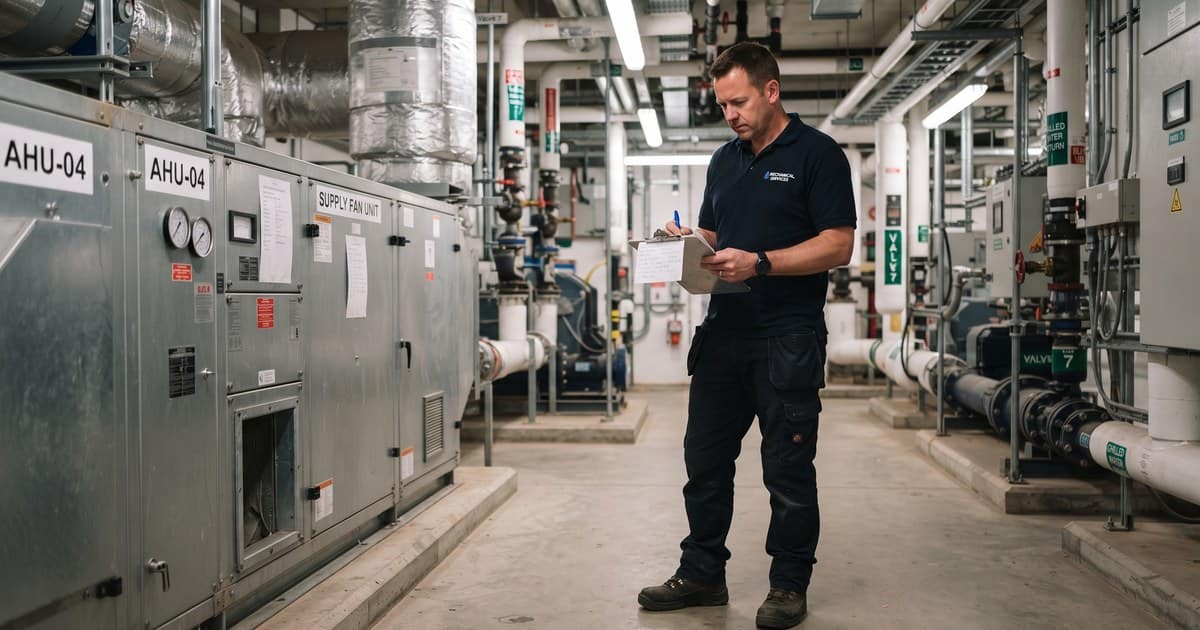
FM engineer recording maintenance observations beside commercial HVAC plant equipment
The Breakdown That Was Never a Surprise
The chiller fails on the hottest day of the year. The emergency call-out costs four times what a scheduled service would have. The repair takes three days because a critical part is not in stock. The building’s tenants are unhappy. The FM manager spends the next week explaining to leadership why this was not anticipated.
The truth is, it was anticipated — just not documented. Most experienced FM professionals know which assets are at risk, which are overdue for service, and which have been quietly deferred because the budget was tight or the contractor was unavailable. The problem is that this knowledge lives in one person’s head, not in a system. When that person is on leave, has moved on, or is simply too busy to act, the asset fails.
Reactive maintenance is not a failure of technical knowledge. It is a failure of planning discipline. And the tool that closes that gap is not expensive software or a complex CMMS implementation. It is a structured 12-month preventive maintenance calendar — a document that tells your team what to service, when to service it, and how to prioritise when resources are constrained.
Why Reactive Maintenance Is Always More Expensive
The cost comparison between reactive and preventive maintenance is well established in FM practice, but the numbers are worth stating clearly. Industry benchmarks consistently show that reactive maintenance costs three to four times more per intervention than planned maintenance on the same asset. Emergency call-out rates, premium parts pricing, business interruption costs, and expedited contractor fees all compound the base repair cost.
Beyond the direct cost, reactive maintenance creates three secondary problems that planned maintenance avoids.
First, it concentrates risk. An asset that fails without warning takes the whole system offline. A chiller that is serviced on a schedule rarely fails catastrophically — degradation is caught early, and interventions are minor. An asset that has not been touched in two years tends to fail completely rather than gradually.
Second, it is impossible to budget. Unplanned breakdowns arrive without warning and without respect for budget cycles. Finance teams cannot provision for unpredictable expenditure. FM managers who cannot explain their maintenance spend lose credibility with leadership regardless of how well the building actually runs.
Third, it erodes contractor relationships. Emergency call-outs pull contractors away from their existing commitments. Response times are slower, prices are higher, and the quality of rushed work is lower. A planned maintenance programme, by contrast, allows contractors to schedule visits efficiently, bring the right parts, and allocate qualified technicians rather than whoever is available.
What a Structured PM Calendar Covers
A comprehensive preventive maintenance calendar for commercial facilities should cover eight core asset categories, each with tasks calibrated to the appropriate maintenance frequency.
- HVAC — air handling units, chillers, cooling towers, fan coil units, VAV boxes, and fresh air systems. Monthly filter checks, quarterly drive and bearing inspections, annual coil cleans and full services.
- Electrical systems — main switchboards, distribution boards, UPS systems, emergency lighting, and thermographic surveys. Statutory inspection intervals must be anchored to the calendar, not left to memory.
- Plumbing and water — booster pumps, hot and cold water systems, legionella risk management, backflow preventers, and water quality testing. Legionella compliance alone justifies a structured calendar on most sites.
- Fire and life safety — sprinkler systems, fire alarm panels, detection devices, emergency lighting, and evacuation equipment. These are statutory obligations with fixed inspection intervals in every jurisdiction. Missing them is not a budget decision — it is a regulatory failure.
- Vertical transportation — lifts, escalators, and platform lifts. Statutory inspection and certification requirements under ASME A17.1 and equivalent standards must be locked into the calendar annually.
- Building envelope — roof membrane, facade and glazing, waterproofing, drainage, and external hardstanding. Typically quarterly and semi-annual inspections with one comprehensive annual survey.
- Security systems — access control, CCTV, intruder detection, and intercom systems. Often overlooked in PM planning until a system fails during an incident.
- Indoor air quality and environmental — water quality testing, waste management areas, energy metering, and refrigerant management. The refrigerant log is a CRITICAL task on sites with F-gas or AIM Act obligations.
Each task should carry a priority rating — CRITICAL (life safety and regulatory), HIGH (critical asset, high operational impact), MEDIUM (standard operational PM), and LOW (non-critical or cosmetic). This rating determines what happens when a task cannot be completed on schedule: CRITICAL tasks are never deferred without escalation to the FM Director; LOW tasks can roll up to 30 days with documentation.
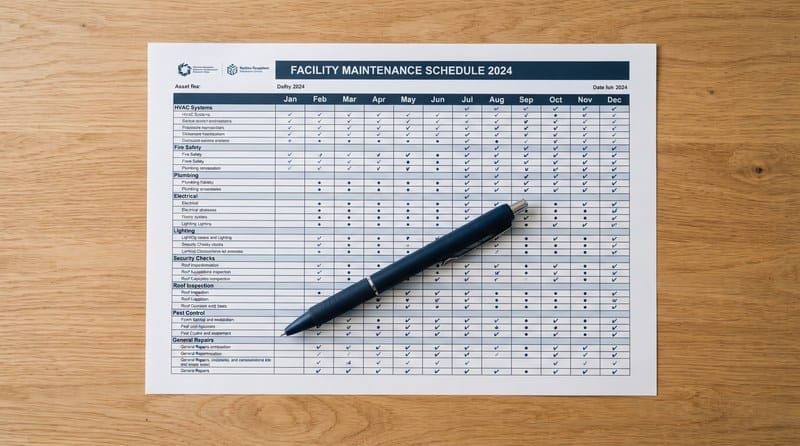
12-month FM maintenance schedule showing asset categories, monthly task frequency, and completion tracking across HVAC, electrical, plumbing, and life safety systems
What Happens When the Calendar Does Not Exist
I took over responsibility for a data centre campus in Asia-Pacific that had been operating for six years under a reactive-only maintenance model. The previous FM team had managed by walking the plant — experienced engineers who knew every piece of equipment and could tell by sound and feel when something was developing a problem. It was effective until it was not.
When two of those engineers left within the same quarter, the institutional knowledge left with them. Within four months, three significant equipment failures occurred: a cooling tower fan motor seized, a primary electrical switchboard developed a fault that had been visible in the last thermographic survey but not actioned, and a fire damper failed its annual test because no one had tracked when it was last serviced.
The cost of those three failures — emergency repairs, temporary cooling hire, and regulatory remediation — exceeded what a structured PM programme for the entire campus would have cost for two years. We implemented a 12-month PM calendar across all eight asset categories within six weeks. In the three years that followed, major equipment failures dropped by over 70%. More importantly, every engineer on the team could pick up the calendar on their first day and understand exactly what was due and why.
That is what a PM calendar does that an experienced engineer’s memory cannot: it makes the maintenance programme institutional rather than personal. The knowledge belongs to the organisation, not to the individual.
| “In 20+ years of FM operations across Asia-Pacific and Europe, I have seen the same pattern on site after site: the FM operation runs well because of one or two highly experienced people, and becomes vulnerable the moment they leave. A structured preventive maintenance calendar is the single most effective tool for converting individual expertise into institutional resilience.” |
How to Build a PM Calendar That Actually Gets Used
A PM calendar that sits in a folder and is never consulted is not a PM programme. The format and discipline of the calendar determine whether it becomes an operational tool or a compliance tick-box.
Four principles make the difference.
Asset-anchored, not task-anchored. Each row in the calendar should correspond to a specific asset or asset group — not a generic task description. “Inspect air handling units” is not an asset-anchored task. “AHU-01 — filter replacement and drive inspection” is. When a task is tied to a specific asset, accountability is clear and completion can be tracked.
Frequency set by manufacturer and standard, not by habit. Every task frequency should be justified by either the manufacturer’s maintenance specification, a relevant standard (NFPA 70B for electrical equipment, ASHRAE 241 for HVAC, ISO 45001 for safety management), or a statutory inspection requirement. “We’ve always done it quarterly” is not a justification. When frequencies are evidence-based, they are defensible to insurers and auditors.
Priority ratings that drive behaviour. The calendar is most useful when it creates clear decision rules for constrained resources. If a contractor cancels, which tasks can wait and which cannot? A CRITICAL/HIGH/MEDIUM/LOW priority structure answers that question without requiring a judgement call from whoever happens to be in the office that day.
A completion record that is updated monthly. A PM calendar without completion tracking is a schedule, not a programme. The completion record is your audit evidence. It is what you produce when an insurer asks whether the chiller was serviced before it failed. It is what protects the FM team when something goes wrong despite following the schedule.
The Calendar, Ready to Deploy
I have packaged a complete 12-month FM preventive maintenance calendar — covering all eight asset categories, 80+ scheduled tasks per month at peak, CRITICAL/HIGH/MEDIUM/LOW priority ratings, and a compliance summary framework — into the BizzXpert FM Operations Playbook Pack Starter tier. It references NFPA 70B, ASHRAE 241, ASME A17.1, and ISO 45001 frequency standards so that every task interval is defensible, not arbitrary. Fully editable Word format, structured for immediate use on any commercial facility.
→ Get the FM Operations Playbook Pack — Starter Tier at the BizzXpert Store
Excellent overview of preventive maintenance planning. The article clearly explains how a structured maintenance calendar reduces downtime, controls costs, improves compliance, and helps teams stay proactive instead of reactive. Thanks for sharing these valuable facility management insights!
Thanks, Nickola. Happy that you liked it.