
A missed break date starts here — the moment a lease obligation surfaces without warning.
The Date That Passed Without Anyone Noticing
The break clause is in Clause 14.2. The notice period is six months. The break date is the fifth anniversary of the lease commencement. No one flagged it. The property lawyer who handled the original lease negotiation moved firms two years ago. The FM Director who managed the site at commencement has since left. The current team knew there was a break clause — it came up in passing at a budget review eighteen months ago — but no one had confirmed the exact notice deadline, and no one had set a calendar alert.
The break date passes. The option is forfeit. The organisation is now committed to the space for the remaining term of the lease, on the existing rent, with no ability to exit. The financial exposure is significant. The cause is not legal complexity — the clause was clear. The cause is the absence of a single structured document that would have surfaced that date and triggered an alert twelve months in advance.
This scenario — a missed break clause, a rent review that passes without challenge, a dilapidations liability discovered six months before lease expiry with no time to commission a Schedule of Condition — is the lease management failure pattern that appears most frequently in property and FM professional forums. It is not a failure of expertise. It is a failure of documentation.
Why Lease Information Lives in the Wrong Place
In most organisations, the executed lease lives in legal’s filing system. The FM team receives a summary at commencement — sometimes a solicitor’s report, sometimes a one-page heads of terms — and then manages the property from that summary indefinitely. When the summary is incomplete, out of date, or simply hard to retrieve, decisions get made from memory and assumption.
The problem compounds on multi-site portfolios. A Corporate Real Estate team managing twenty leased properties across different markets, different lease commencement dates, different rent review mechanisms, and different repairing obligations cannot hold all of that information in a consistent, accessible form without a structured system. The alternative — reviewing the full lease every time a decision needs to be made — is time-consuming, error-prone, and simply does not happen in practice.
The FM team is often the last to know about critical lease obligations. Rent review notices, break clause deadlines, and dilapidations provisions are treated as legal matters. They are — but they are also FM operational matters. The condition of the premises at lease expiry, the repairing obligations the tenant carries, the permitted alterations, the approved contractor list, the hours of access to plant — these are all FM responsibilities that live inside the lease document and are invisible to the FM team until something goes wrong.
What a Lease Abstract Actually Does
A lease abstract is not a legal document. It is a structured reference document that extracts every operationally and commercially significant term from the executed lease and presents it in a format that the FM team can use for day-to-day decisions and forward planning.
A well-constructed FM lease abstract has three functions that a lease summary or heads of terms does not.
It captures FM operational obligations, not just commercial terms. Rent, term, and break clauses are the commercial FM’s domain. But the FM Director also needs to know: who is responsible for HVAC maintenance and whether it is recharged by the landlord? What are the permitted hours of contractor access to the plant room? Is the tenant required to maintain the premises in a specific decorative standard? Are there approved contractor lists that bind the FM team’s choice of suppliers? These terms live in the repair, maintenance, and special conditions sections of the lease and are routinely missed in standard lease summaries.
It creates a Key Dates Diary with mandatory alert lead times. A lease abstract without a Key Dates Diary is a reference document. A lease abstract with a Key Dates Diary is a management tool. Every critical lease event — rent review notice deadline, break clause exercise window, option to renew deadline, lease expiry, insurance certificate renewal, service charge reconciliation — should be captured with the alert lead time built in. Rent review: 12 months. Break clause exercise deadline: 12 months. Lease expiry for complex leases: 18 months. These are not arbitrary timelines — they reflect the minimum preparation time required to take action before the event rather than react to it.
It creates a version-controlled record that travels with the property. When an FM Director moves on, the lease abstract stays. When a new property manager takes over the portfolio, the abstract is the onboarding document. When a dilapidations dispute arises at lease expiry, the abstract is the chronological record of how the obligations were understood and managed throughout the term. This institutional continuity is the single most important function of the lease abstract — and the one most completely absent when the lease information lives only in one person’s head or in a legal filing system that the FM team cannot access.
What a Complete FM Lease Abstract Covers
A lease abstract structured for FM use should cover fourteen areas:
- Parties and property identification — landlord, tenant, managing agent, property address, floor and unit details, tenure type
- Lease term and tenure — commencement, expiry, rent-free period, fit-out period, options to renew, holding over provisions
- Rent and rent reviews — base rent, payment frequency, review type (fixed, CPI, market), review dates, ratchet provisions, notice requirements
- Security and incentives — security deposit, bank guarantee, rent-free incentives, landlord contribution to fit-out
- Service charge — budget, cap, reconciliation process, exclusions, management fee structure
- Permitted use and alterations — what the premises may be used for, what alterations are permitted, what requires landlord consent, reinstatement obligations
- Break clauses — tenant and landlord break dates, notice periods, pre-conditions (rent arrears, reinstatement), consequences of invalid exercise
- Repair, maintenance and dilapidations — repairing standard, HVAC responsibility, decoration obligations, Schedule of Condition, dilapidations cap, yield-up condition
- Insurance — building insurance party, tenant public liability minimum, employer’s liability, certificate of currency obligations
- Assignment and subletting — permitted assignment conditions, subletting rights, landlord consent requirements
- Guarantees — guarantor identity, guarantee amount, conditions and release provisions
- Key Dates Diary — all critical dates calendared with mandatory alert lead times
- Special conditions and onerous clauses — any non-standard provisions that create FM operational obligations
- Lease document register — version control, sign-off record, storage location for originals
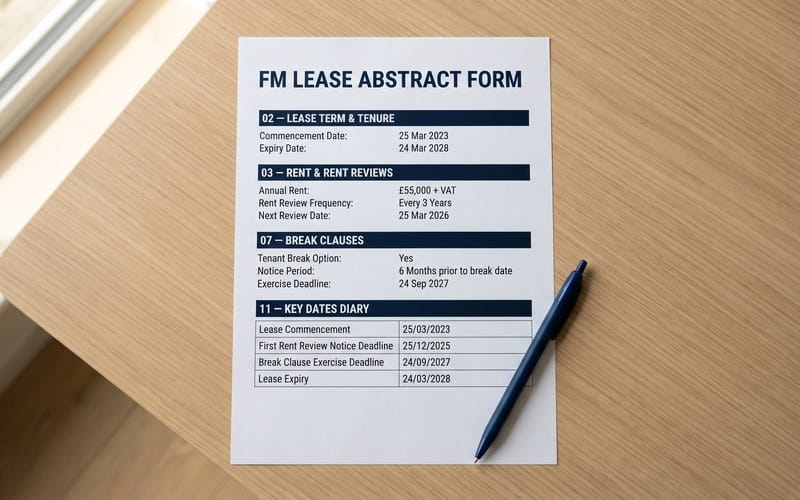
A complete FM Lease Abstract Form — structured sections, Key Dates Diary, ready to complete.
What Happened When We Standardised Lease Abstracts Across a Hong Kong Portfolio
I managed a commercial office portfolio in Hong Kong — eleven leases across seven buildings, with lease commencement dates spread across a nine-year window. When I took over the portfolio, lease information was held in three places: the legal team’s file server (access restricted), a shared drive with a folder per building containing documents of varying vintage, and the outgoing FM Director’s personal notes, which were thorough but not transferable.
Within the first month, a rent review notice arrived from one landlord’s solicitor. We had not initiated the review ourselves because the review date was not in any FM-maintained record. Under the lease terms, the landlord’s surveyor had already been appointed and a proposed rent increase of 18% was on the table. We were reactive from the opening position.
We commissioned a full lease abstract for every property in the portfolio. Fourteen sections per lease, completed by the FM team with legal review on the flag items. The Key Dates Diary for each property was immediately calendared with twelve-month advance alerts. Within three months, two upcoming break clause windows were identified that no one on the FM team had been tracking. One was exercised; one was allowed to run because the market terms at renewal were more favourable than the exit would have been.
The abstracts also surfaced three properties where the tenant’s HVAC repairing obligation extended further than the FM team had understood — the landlord was recharging maintenance costs that the lease did not support. The recovery from one of those properties alone covered the time invested in the abstraction exercise.
|
The Abstract, Ready to Complete
I have packaged a complete FM Lease Abstract Form — fourteen sections covering all commercial, operational, and compliance lease obligations, a Key Dates Diary with recommended alert lead times built in, a version control and sign-off record, a Lease Document Register, and an AI Prompt Toolkit for lease term extraction, rent review notice drafting, break clause exercise checklists, and dilapidations risk assessment — into the BizzXpert FM Operations Playbook Pack Pro tier. One form per lease. Keep it updated at every lease event. It is the single reference document that eliminates repeated full-lease review for every routine decision and ensures no critical date is ever missed.
→ Get the FM Operations Playbook Pack — Pro Tier at the BizzXpert Store